
A deep neural network (DNN) is a type of artificial intelligence (AI) system designed to recognize patterns and relationships in data through a structure inspired by how the human brain works. It is called “deep” because it contains multiple layers of interconnected processing units—called neurons—that progressively transform raw input into meaningful output. Deep neural networks are the foundation of many modern technologies such as voice recognition, image classification, language translation, and self-driving cars.
1. Structure of a deep neural network
A deep neural network is composed of three main types of layers:
- Input layer – This layer receives the raw data. For example, in image recognition, each pixel’s intensity value can be an input.
- Hidden layers – These layers process the information. Each hidden layer extracts increasingly abstract features from the input. The more hidden layers there are, the “deeper” the network becomes.
- Output layer – This layer produces the final result, such as a predicted category (e.g., “cat” or “dog”) or a numeric value (e.g., the probability of a disease).
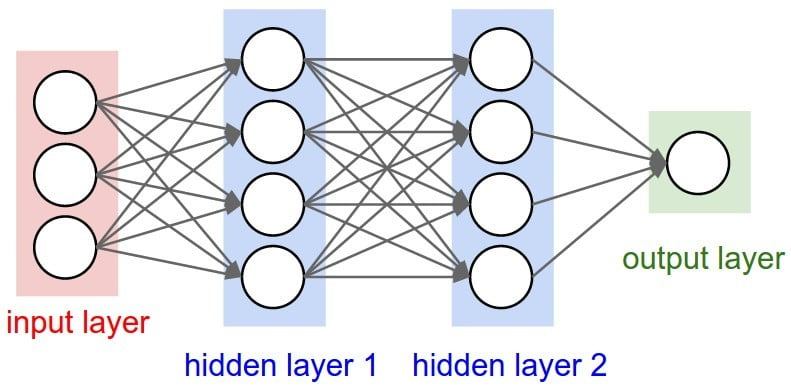
Each neuron in a layer is connected to many neurons in the next layer through weights, which are numerical values that determine how much influence one neuron has on another. Neurons also have biases, which adjust how easily they become active.
When an input passes through the network, it is multiplied by weights, added to biases, and then processed by an activation function, which determines whether and how much a neuron “fires.” Common activation functions include:
- Sigmoid – Maps input to a value between 0 and 1.
- ReLU (Rectified Linear Unit) – Passes positive values as they are and turns negative values into zero.
- Tanh – Scales input between -1 and 1.
2. How a deep neural network learns
The process of training a DNN involves adjusting its weights and biases so that the network produces correct outputs for given inputs. This happens through several key steps:
Step 1. Forward propagation
Data passes through the network from input to output. Each layer processes the data and transforms it before passing it on. The final output is compared to the correct (target) value.
Step 2. Loss function
The loss function measures how far the network’s output is from the correct answer. For example, in predicting whether an image contains a cat, the loss might be high if the network predicts “dog” instead.
Step 3. Backpropagation
The network then works backward from the output to the input using a method called backpropagation. This technique calculates how much each weight and bias contributed to the error and determines how they should be adjusted.
Step 4. Optimization
An optimizer such as stochastic gradient descent (SGD) or Adam updates the weights and biases slightly in the direction that reduces the loss. The process repeats for thousands or millions of examples until the network performs accurately.
3. Why “deep” networks are powerful
Each layer in a DNN learns to detect more complex patterns than the previous one. For example:
- In an image recognition DNN:
- The first layer may detect simple features like edges or corners.
- The next layers may detect shapes or textures.
- Deeper layers can recognize complete objects such as faces, cars, or animals.
This hierarchical feature learning allows deep networks to automatically extract useful representations from raw data, without needing manual programming of features.
4. Types of deep neural networks
Different architectures are designed for specific types of data and problems:
- Feedforward neural networks (FNNs) – The simplest type, where information moves only in one direction (forward).
- Convolutional neural networks (CNNs) – Designed for image and video processing; they use convolutional layers to detect spatial patterns.
- Recurrent neural networks (RNNs) – Designed for sequential data such as speech or text; they have memory connections that allow information to persist over time.
- Transformers – Modern architectures that excel at processing sequences (especially in natural language processing) by using attention mechanisms instead of recurrence.
- Autoencoders – Used for data compression and noise reduction by learning efficient internal representations.
- Generative adversarial networks (GANs) – Composed of two networks (a generator and a discriminator) that compete to produce realistic synthetic data, such as human-like faces or voices.
5. Applications of deep neural networks
Deep neural networks are now used in many areas of science, technology, and everyday life:
- Computer vision – Object recognition, facial identification, medical imaging analysis.
- Natural language processing – Translation, chatbots, text summarization, sentiment analysis.
- Speech recognition – Voice assistants such as Siri, Alexa, and Google Assistant.
- Healthcare – Predicting diseases, analyzing scans, discovering new drugs.
- Finance – Fraud detection, stock market prediction, credit scoring.
- Autonomous systems – Self-driving cars, drones, industrial robots.
6. Challenges and limitations
Despite their success, DNNs have several challenges:
- Data requirements – They need very large and diverse datasets for effective training.
- Computational cost – Training can require powerful hardware like GPUs or TPUs and significant energy consumption.
- Black-box nature – It is often difficult to understand how or why a DNN makes a particular decision.
- Overfitting – When a network learns the training data too well but performs poorly on new data.
- Bias and fairness – If the training data contains human bias, the model may reproduce or amplify it.
7. The future of deep neural networks
Research continues to make DNNs more efficient, explainable, and capable. Current directions include:
- Smaller and faster models for mobile devices (e.g., model compression, pruning, quantization).
- Explainable AI (XAI) to make neural network decisions more transparent.
- Multimodal networks that process combined data (e.g., text, image, and sound).
- Self-supervised learning that reduces dependence on labeled data.
- Neuromorphic computing inspired by biological neurons for energy-efficient AI.
In summary, a deep neural network is a layered computational system that mimics the way the human brain processes information. By learning from vast amounts of data, it can identify complex patterns, make predictions, and perform tasks that once required human intelligence. Its power lies in its ability to automatically learn features from raw input through multiple layers of abstraction—an ability that continues to reshape technology, science, and society.