
Artificial neural networks (ANNs) are computational systems inspired by the structure and function of the human brain. They process data through interconnected layers of nodes—called neurons—that adjust their internal parameters (weights and biases) to recognize patterns, classify information, and make predictions. Over the past decades, neural networks have evolved from theoretical constructs into powerful engines that drive many of today’s technologies, from voice assistants to self-driving cars. This article explains and discusses the wide range of neural network applications, how they work, and why they have become central to modern artificial intelligence (AI).
1. How neural networks work
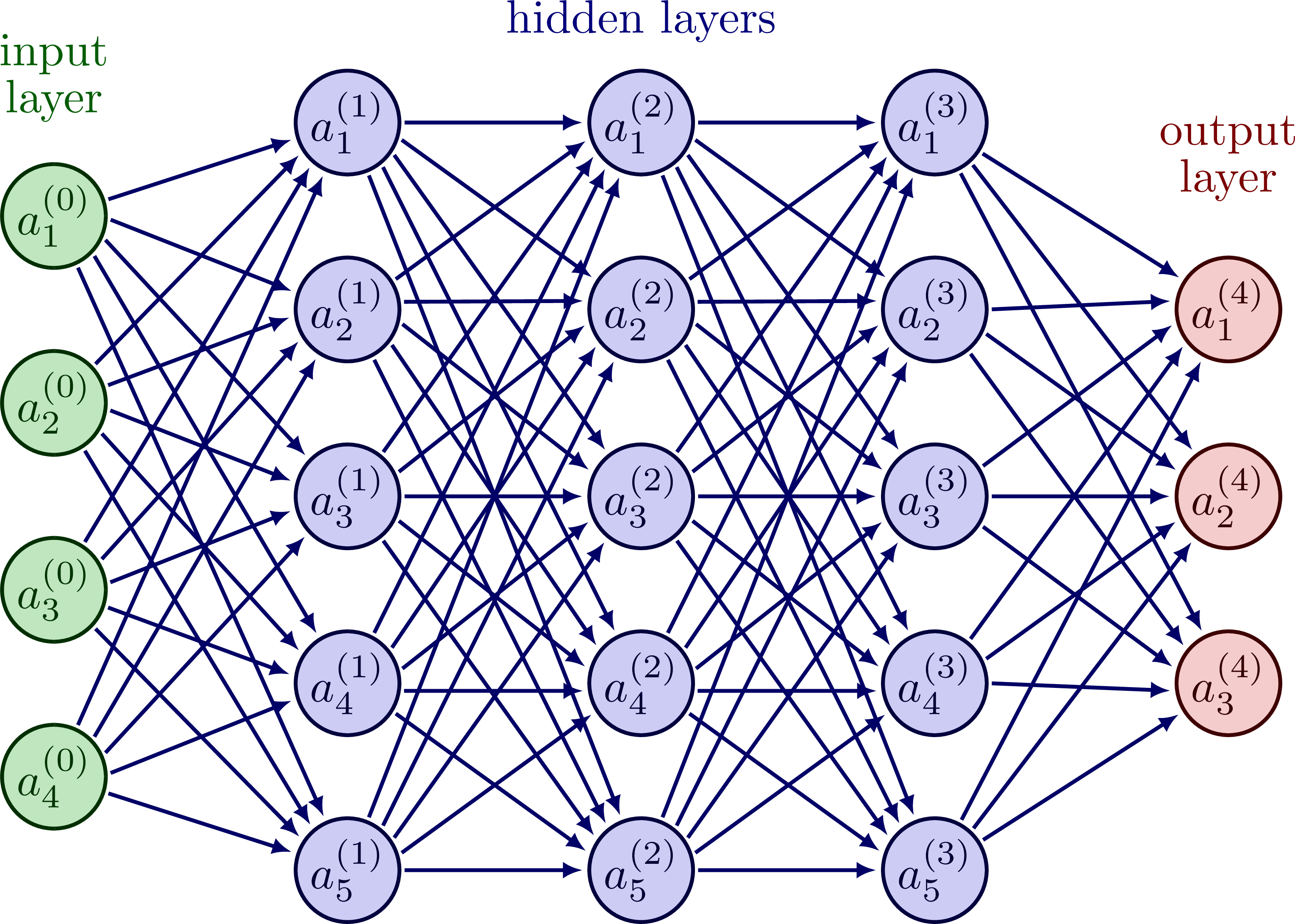
A neural network consists of three main parts:
- Input layer – where data (such as images, text, or numbers) enter the system.
- Hidden layers – where nonlinear transformations and learning occur.
- Output layer – where the network produces its final prediction or decision.
Each neuron receives input values, multiplies them by adjustable weights, sums them, applies an activation function (for example, sigmoid or ReLU), and passes the result forward. Through repeated exposure to data and optimization by algorithms such as backpropagation and gradient descent, the network “learns” to minimize errors. This mechanism allows it to capture complex relationships that traditional algorithms often fail to detect.
2. Image recognition and computer vision
One of the most successful applications of neural networks lies in computer vision.
2.1 Convolutional neural networks (CNNs)
CNNs are designed to process visual information by applying filters that detect features such as edges, colors, and shapes. As layers progress, they learn more abstract features, like object parts or entire objects.
2.2 Real-world uses
- Facial recognition: CNNs identify and verify faces in smartphones, surveillance systems, and border security.
- Medical imaging: They detect tumors in MRI scans, classify skin lesions, and assist radiologists by highlighting abnormal structures.
- Autonomous vehicles: CNNs interpret road scenes, detect pedestrians, and read traffic signs in real time.
These applications demonstrate how neural networks can interpret complex visual inputs faster and more consistently than humans under certain conditions.
3. Natural language processing (NLP)
Neural networks have revolutionized how computers understand human language.
3.1 Recurrent and transformer architectures
Traditional recurrent neural networks (RNNs) and long short-term memory (LSTM) networks handle sequential data by remembering previous words. However, modern transformer models—like GPT or BERT—use self-attention mechanisms to process all words in parallel while preserving their contextual relationships.
3.2 Applications
- Machine translation: Neural networks enable systems like Google Translate to learn from massive multilingual datasets and produce natural, context-aware translations.
- Speech recognition: They convert spoken language into text in digital assistants like Siri, Alexa, and Google Assistant.
- Text generation and summarization: Neural networks create coherent articles, generate code, or summarize long documents by predicting the next most likely words.
These systems show that neural networks can model the intricate dependencies of human language, something rule-based systems never achieved.
4. Financial and business analytics
In finance and business, neural networks analyze large volumes of structured and unstructured data to uncover patterns invisible to traditional statistical models.
4.1 Applications
- Fraud detection: Networks detect unusual spending patterns or transaction anomalies in real time.
- Credit scoring: They evaluate creditworthiness using data beyond conventional credit history, such as spending behavior or social interactions.
- Stock market prediction: Deep learning models identify correlations and trends in market data, although their predictive accuracy remains debated.
- Customer behavior analysis: Businesses use neural networks to personalize recommendations and forecast demand.
These applications illustrate the economic power of neural networks in decision-making and risk management.
5. Healthcare and medical research
Healthcare has become one of the most transformative fields for neural network applications.
5.1 Diagnostic assistance
CNNs analyze X-rays, CT scans, and pathology slides to identify diseases such as pneumonia or cancer at early stages.
5.2 Predictive modeling
Neural networks can predict disease progression, hospital readmissions, or patient outcomes based on medical histories and genetic information.
5.3 Drug discovery
Deep learning models simulate molecular interactions and propose candidate drugs faster than traditional chemical screening methods.
The integration of neural networks into healthcare demonstrates how machine intelligence can enhance human expertise rather than replace it.
6. Autonomous systems and robotics
Neural networks give machines the ability to perceive and act in the physical world.
- Autonomous vehicles: They interpret sensory data from cameras, radar, and LiDAR to make driving decisions.
- Drones and industrial robots: They use reinforcement learning—where networks learn by trial and error—to optimize movements and improve precision.
- Smart prosthetics: Neural interfaces use deep learning to translate brain or muscle signals into mechanical control commands.
In these systems, neural networks provide the perception, planning, and adaptation needed for real-time decision-making.
7. Creative and artistic domains
Neural networks are not confined to analytical tasks; they also participate in creativity.
- Generative Adversarial Networks (GANs): These models create realistic images, music, and videos by having two networks compete—a generator that produces content and a discriminator that evaluates it.
- Style transfer: Neural algorithms can paint photos in the style of Van Gogh or Picasso.
- Music and literature: Models compose songs, write poetry, or generate visual art based on learned patterns.
While debates continue over the meaning of “machine creativity,” these systems demonstrate how learning algorithms can imitate or extend human artistic expression.
8. Scientific research and engineering
Neural networks contribute to solving complex scientific problems:
- Climate modeling: They predict temperature patterns and simulate atmospheric changes.
- Particle physics: They identify rare events in massive datasets from experiments like the Large Hadron Collider.
- Structural engineering: Networks assist in material design and stress prediction.
- Biology: They help reconstruct protein structures (as in DeepMind’s AlphaFold).
These applications demonstrate that neural networks are not just tools of convenience but engines of discovery.
9. Challenges and ethical concerns
Despite their success, neural networks face major challenges:
- Opacity: Neural networks are often “black boxes,” making their decisions hard to interpret or verify.
- Bias: Training data can encode social or cultural biases, leading to unfair outcomes.
- Energy consumption: Large models require vast computing power and electricity, raising sustainability concerns.
- Data privacy: The collection of massive datasets risks exposing sensitive information.
To address these issues, researchers are developing explainable AI (XAI), bias correction methods, and energy-efficient architectures.
10. The future of neural network applications
Neural networks continue to evolve through new paradigms such as neuromorphic computing, spiking neural networks, and federated learning, which aim to make AI faster, more adaptable, and more secure. As they integrate further into daily life, from personalized education to environmental monitoring, their impact will expand beyond technology into the ethical, cultural, and philosophical domains of human society.
Neural networks have transformed how machines perceive, reason, and create. They underpin a wide range of applications—from image recognition and natural language processing to finance, healthcare, and art—by learning from data in ways that resemble human intuition. However, with their power comes responsibility: ensuring transparency, fairness, and sustainability is as critical as advancing their performance. The story of neural networks is not only one of engineering progress but also of how humanity defines and governs intelligence itself.